
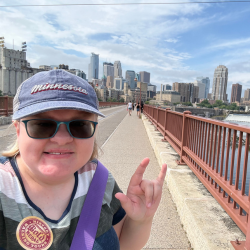
Hello, my name is Shannon, and I am 36 years old with CHARGE syndrome. I live in Minnesota, and I love my state. American Sign Language is my first language, and it is part of who I am as a Deaf person. I don’t speak with my voice; my hands are my voice. I sign to communicate what I want to say.
I want to share one story. I work as a teacher aide at a Deaf school. Many kids come to school with little or no language. We teach them sign language. It is part of their community and culture. Some people don’t realize how ASL helps people express themselves and communicate because it is a visual language.
I worked in a Birth to Three program classroom. One toddler was pointing to something he wanted on a shelf. I pointed to something. He shook his head no. I pointed to something else. No. Something else. He started crying in frustration because he couldn’t express what he wanted.
Finally, I pointed to the puzzles. His eyes lit up, and he cheered. I then signed PUZZLE to him. He copied me.
It happened again and again, day after day. Weeks. Weeks. I reminded him of the sign every time. Then finally, one day, he came to me and independently signed, WANT PUZZLE.
He finally expressed himself.
This is why I feel every child deserves a way to communicate, express their needs, and have access to American Sign Language. Sign language is not just a tool; it is a language and an important part of Deaf people’s lives.
Now, as a teacher aide, I get to watch children discover the power of sign language. They can tell me what they want with their hands. This is why language access matters.
ASL gave me a voice through my hands. Now I get to help children discover that their hands can have a voice, too.
For International Day of Sign Languages, I want to share a few things people may not know. Sign language is not universal. Different countries have their own sign languages, such as American Sign Language and British Sign Language. Sign language is a language. It has its own rules, grammar, and structure. Deaf people have the right to access language for communication.
Sign languages have existed for centuries, and Deaf people have fought to protect them. In 1880, an international conference in Milan supported oral education and rejected the use of sign language in schools. This led to sign language being suppressed in many Deaf schools. Deaf people continued to sign with each other and keep their language alive. Over time, sign languages became more recognized in many places.
Today, more and more schools teach sign language. It is important to teach sign language at an early age. There is a myth that sign language prevents spoken English. Both can work together.
International Day of Sign Languages is not only a day to celebrate how beautiful sign languages are. It is also a day to remember why protecting Deaf people’s language and communication rights matters. I also want to share a quote from George Veditz’s 1913 film The Preservation of the Sign Language: “It is my hope that we will all love and guard our beautiful sign language as the noblest gift God has given to deaf people.” It is still true.
