
The Roles and Responsibilities of the Team Members
Presented by: Gloria Rodriguez-Gil, Educational Specialist, California Deaf-blind Services
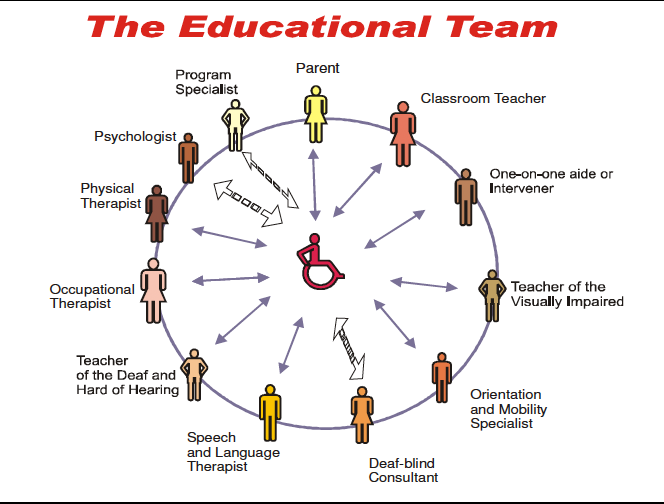
“They all have an expertise—but no team member can work autonomously of the others.” –Terry Boisot, parent
Parent
- Is the driving force, one of the leaders of the team
- Holds the big picture, consistent team member
- Is a unique source of information: on the child, on CHARGE syndrome
- Shares information and helps develop goals the child will accomplish during the school year
- Advocates strongly but also needs to be very sensitive to educators needs and fears
- Promotes team collaboration
Program Specialist
- Responsible to manage individual cases
- Generally has basic knowledge of the child’s disabilities
- Attends educational decision-making meetings, where services for the student are discussed
- Supports the educational team work to better serve the student
- Develops the IEP document fully describing the services that will be delivered and how services these will be implemented
- Provides the student with an educational program that not only addresses academic achievement but social-emotional
Classroom Teacher
- Person in charge in the classroom
- Must work in collaboration with the IEP team
- Must collaborate with team members to adapt the classroom environment, activities, materials to be accessible to the student
- Must promote socialization amongst classmates and schoolmates
- Ideally must work directly with the child
One-to-one Assistant/ Intervener
- Deaf-blindness is a disability of access to visual and auditory information
- Individuals with deaf-blindness need environmental access, communication and social-emotional support
- The role of an intervener is to facilitate this process
- The intervener is a paraprofessional with abilities and specialized training to provide direct support to a deaf-blind individual
- The decision of having an intervener is based upon the level of support needed by the student to access the information
- The intervener is the bridge/connection between the individual with deaf-blindness and the world
Teacher of the Visually Impaired
- Performs functional visual assessment
- Refers the student to a low vision clinic for evaluation
- Evaluates and supports with visual aids
- Determines which visual materials are appropriate for the student. (i.e., size, color, contrast)
- Adapts written materials, ( i.e., large print, Braille)
- Evaluates and modifies visual environment
- Provides Braille instruction
- Many VI Teachers have limited experience working with deaf or hard of hearing or students with multiple disabilities
Orientation and Mobility Specialist
- Helps a student who is blind or with low vision know where he is in space and where he wants to go (orientation)
- Helps a student who is blind or with low vision to have a plan to get there (mobility)
- This specialist has experience traveling in space blindfolded or with low vision goggles
- Teaches student the concepts of space, environment and how to use the information received through other senses (sound, temperature, vibration) to maintain or redirect orientation
- Teaches the student how to use the white cane and dog guide as support or as the only instrument of guidance
- Teaches the student how to use residual vision and low vision aids when traveling
- Helps the student to learn about his environment and the language that the student needs to use in that environment
- Develops adaptations that will allow the student to interact with the public (e.g., communication cards in public transportation)
Deaf-Blind Specialist (CA)
- Provides statewide and regional trainings to IEP teams
- Provides technical assistance in person, via telephone, Internet and video
- Provides urgent technical assistance
- Helps create and participate in a family-to-family support network
- Disseminates information, resources and products
Speech-Language Therapist
- Identify student’s speech problems
- Evaluates students with speech problems
- Refers students to medical professional for further evaluation
- Provides speech-language services to improve or prevent communication issues
- Provides counseling and guidance to parents, children and teachers in the area of speech-language
- Some therapists know about other modes of communication such as Sign Language and augmentative and alternative communication
Deaf and Hard of Hearing Teacher
- Observes the classroom environment to see what can be done to improve the student’s learning
- Checks for properly functioning hearing aids, FM systems, cochlear implants
- Determines with the educational team the best way to communicate with the student (speech, volume, distance, Sign Language, object cues, etc.)
- Knows about formal language development in hard of hearing people (spoken and written, comprehension and use)
- Many of these professionals have limited experience working with students who are blind or with low vision or have multiple disabilities and the information given by other team members is important
Occupational Therapist
- Works with fine motor abilities, coordination and strength to improve mobility and physical abilities
- Helps the student to work with available senses
- Works on feeding issues, hand use (manipulatives) and physical independence
- Knows about adapted equipment that can help the student be as independent as possible
- Creates a “sensory diet” (coined by OT Patricia Wilbarger) which is a carefully designed, personalized activity plan that provides the sensory input a person needs to stay focused and organized throughout the day
Physical Therapist
- This service generally works on posture, muscle strengthening, mobility and endurance
- Works on gross motor abilities
- Provides experiences and practice to improve motor development
- Monitors the appropriate use of prescribed durable equipment
Psychological Services
- Performs evaluations/assessments
- Interprets evaluation/assessment results
- Provides consultation to educational team members, to plan educational programs that meet the unique needs of students, according to psychological evaluations, interviews and behavior assessments
- Plans and manages psychological services, including counseling to be provided to students and parents
- Assists in the development of positive behavior plans
Educational Team Members Should…..
- Collaborate as a team
- Provide support to each other
- Share good teaching/working strategies to meet the student’s needs
- Develop goals and objectives together
- Provide services to meet the unique needs of the student
- Provide training as appropriate
- Make sure the IEP is implemented
